Looking Back at the Event «Two Waves of Migration, One Diaspora? Latvians in Sweden»
On February 23, 2026 at 5:00 p.m., researchers from the Institute of Philosophy and Sociology, Faculty of Humanities, University of Latvia, invited the public to a lecture-discussion, «Two Waves of Migration, One Diaspora? Latvians in Sweden», held at the Čiekurkalns Branch Library of the Riga Central Library.
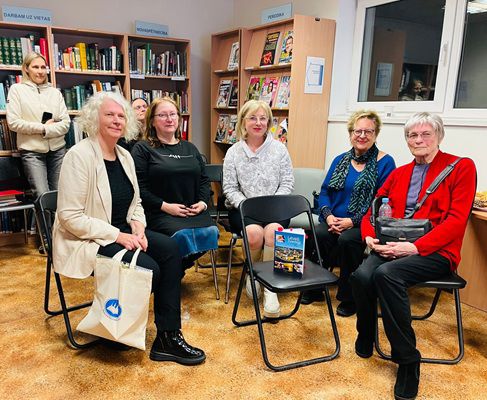
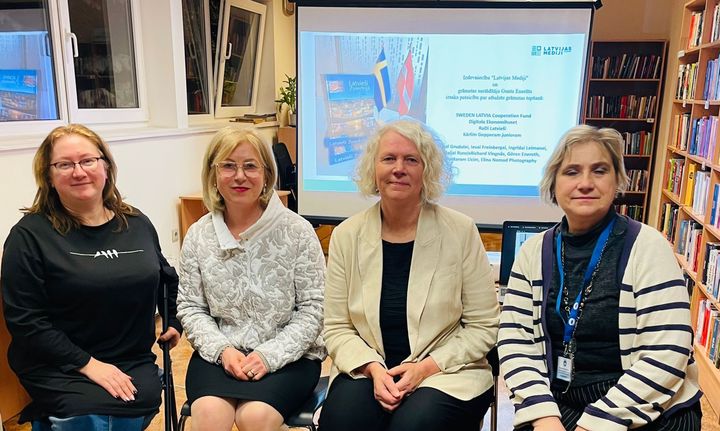 No kreisās: Ginta Elksne, Gunta Enerūta, Daina Grosa, Aija Namvīra
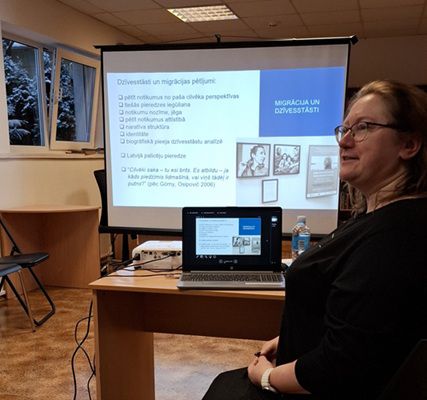
Sociologist and oral history researcher Ginta Elksne provided an overview of migration processes and their long-term impact on Latvia, as well as the research that has been conducted on the Latvian diaspora in Sweden. She presented both scholarly articles and books based on life-history narratives, documenting the experiences of Latvian refugees who fled to Sweden and began rebuilding their lives there. She also discussed the exhibition «Why Did We Leave? Young Latvians in Sweden», which explored the experiences of Latvians who emigrated to Sweden after the restoration of Latvia’s independence.
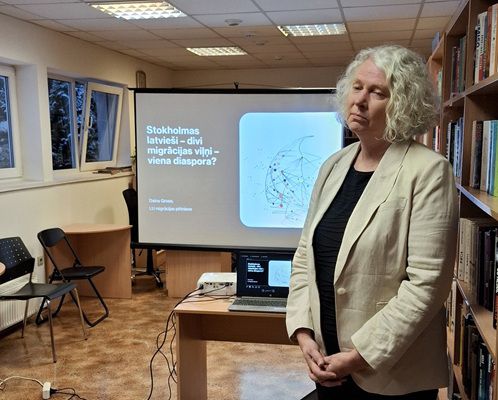
Migration researcher Daina Grosa shared insights from the fieldwork conducted in Stockholm in December 2025 as part of the project «Navigating Post-Exile». Together with Maruta Pranka and Elvis Friks, she interviewed members of the Latvian diaspora and participated in a discussion at the Department of Baltic Languages, Stockholm University on the interaction between the earlier exile community and the newer wave of Latvian migrants.
As Daina Grosa observed, neither the exile community nor the more recent migrant community is homogeneous. Nevertheless, by facing and overcoming different challenges, both groups have found ways to work together to preserve their Latvian identity and cultural heritage. She illustrated this development through the example of the annual 18 November Latvian Independence Day celebrations. During the Soviet occupation of Latvia, these events were marked by a sombre atmosphere and a profound sense of loss for the occupied homeland. Following the restoration of Latvia’s independence, however, the community had to redefine the purpose and format of these commemorations. Another example of this transition is the Latvian school in Stockholm, where today the fourth generation of the exile community and the second generation of the new diaspora meet. The school is now run by representatives of the more recent wave of Latvian emigrants.
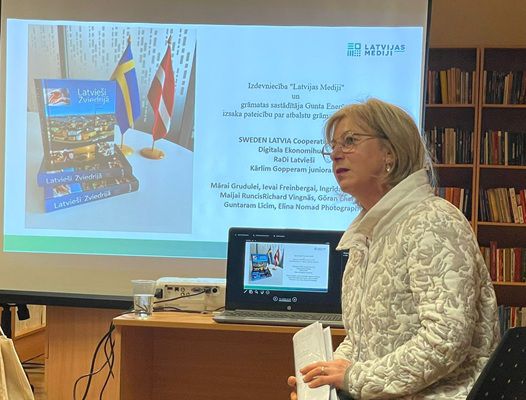
This active segment of the community, those who have long contributed to Latvian community life in Sweden as well as those who continue to do so today, is the focus of journalist Gunta Enerūta (Sweden/Latvia), who now calls Sweden her home. She is the originator and project leader of the book «Latvians in Sweden: Articles, Stories, Memories» published in late 2025. As Gunta Enerūta explained, the book seeks to provide an insight into the beginnings of the Latvian diaspora in Sweden while also documenting at least part of the network of dedicated individuals who have selflessly worked, and continue to work, for what she described as the Latvian cause in Sweden.
She concluded by quoting Jēkabs Kalniņš, actor and set designer of the Stockholm Attractive Latvian Amateur Theatre (SALA): «In this collection, you will discover what Latvians have created and accomplished, what Latvians are creating and doing today, and what Latvians in Sweden will create and achieve in the future while remaining LATVIANS!»
We would like to thank everyone who attended the event and contributed to the discussion, especially Valda Liepiņa and Aija Priedīte, who generously shared their personal experiences of Latvian life in exile. Our sincere thanks also go to Aija Namavīra, Head of the Čiekurkalns Branch Library, for providing the opportunity to host the discussion at the library and for her warm hospitality and support in ensuring a successful event.
The event was organised in collaboration with the University of Latvia’s Faculty of Humanities and the project «Navigating Post-Exile: Transformations and Transitions in the Latvian Exile Community after 1991» (Project No. lzp-2024/1-0114).
Photo: Aija Namavīra un Göran Eneroth.