Looking Back at the Discussion «Returning? Memories of First Visits to Latvia in Life Stories and Literature»
The discussion took place on December 11 at Tintnīca, the cultural space of the Latvian National Museum of Literature and Music (LNMLM). Moderated by literary scholar Elvis Friks, the event explored the theme of return both from the perspective of postexile literature and as a complex social reality in the period following the restoration of Latvia’s independence in 1991.
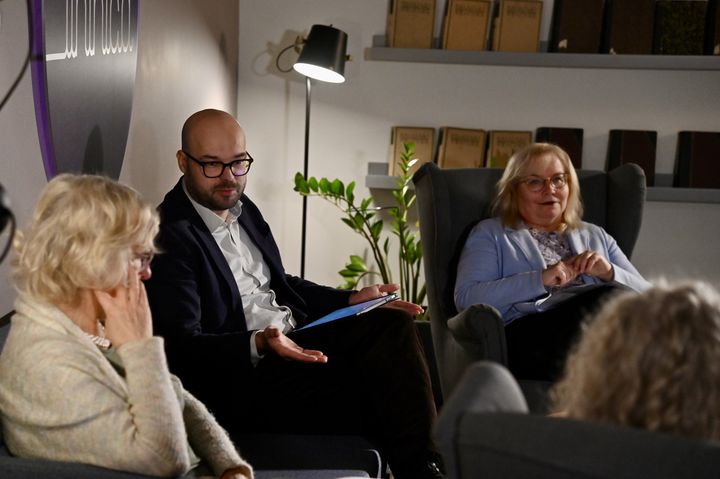 M. Pranka, E. Friks, I. Daukste-Silasproģe. Photo: E. Kursīte, RMM
Oral history researcher Maruta Pranka shared insights from the life-story interviews she has conducted, focusing on the spiritual and emotional return of second-generation members of the Latvian exile community to their Latvian identity and the ethnic heritage passed down by their parents. Participants heard narratives about learning the Latvian language in exile and the challenges this entailed, as well as personal accounts of first encounters with their parents’ homeland, the growing awareness of family roots and history, and the profound experience of realizing, for the first time, that Latvia was a real, existing country.
Sociologist Daina Grosa presented examples from interviews with former exiles and their descendants, illustrating how they first encountered Soviet Latvia. For first-generation exiles, these journeys represented reunions with relatives and inevitably invited comparisons between Soviet Latvia and the independent Latvia they had left behind. For members of the second generation, however, Latvia had long existed primarily through the stories of parents and grandparents, almost as a mythical place. Only upon visiting did these imagined perceptions meet reality. Daina Grosa also reflected on her own experience of returning to her parents’ homeland for the first time and on the journeys that eventually led her to settle permanently in Latvia.
Literary scholar Inguna Daukste-Silasproģe reflected on the visits of Latvian exile writers to Soviet Latvia and explored how these experiences later found expression in their literary works. She introduced visitors to a selection of archival objects from the museum’s collections related to the transformation of the exile community after 1991. She also spoke about the manuscript of Velta Toma’s poem «What Shall I Write Home?..» and the poet’s encounter with readers in Soviet Latvia.
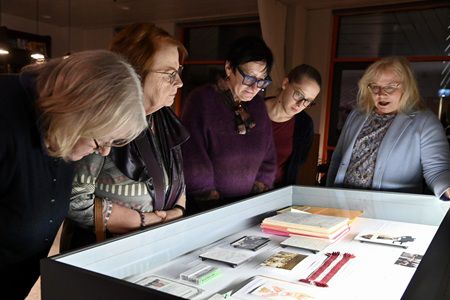
At the conclusion of the discussion, participants were invited to visit a pop-up exhibition from the museum’s collections dedicated to authors associated with the post-exile period.
The event was organised in collaboration with the University of Latvia’s Faculty of Humanities and the project «Navigating Post-Exile: Transformations and Transitions in the Latvian Exile Community after 1991» (Project No. lzp-2024/1-0114).