Research Continues Throughout the Summer!
The summer months have also been filled with active research and participation in international academic conferences. In July, researchers from the project «Navigating Post-Exile: Transformations and Transitions in the Latvian Exile Community after 1991» (No. lzp-2024/1-0114) represented Latvia at two major international academic forums.
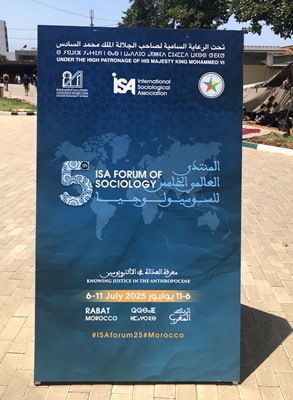
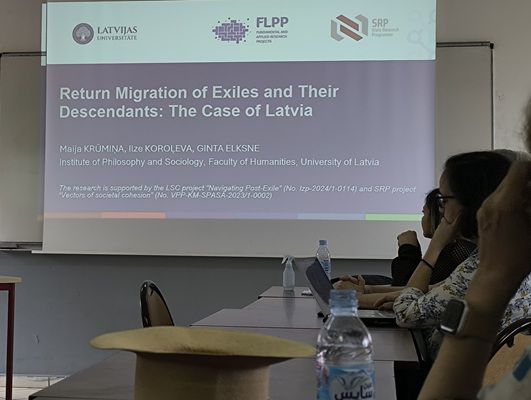
From 1 to 5 July, the 5th Forum of the International Sociological Association (ISA) was held in Rabat, the capital of Morocco, bringing together more than 6,000 sociologists from 126 countries. As part of the forum, Ginta Elksne, Ilze Koroļeva, and Maija Krūmiņa presented their paper, «Return Migration of Exiles and Their Descendants: The Case of Latvia».
The paper examined the complex experiences of Latvian exiles in deciding whether to return to their homeland. It explored the motivations behind return migration, the challenges encountered upon returning, and the emotional, cultural, and social factors that have shaped their integration into Latvian society. Particular attention was devoted to:
🔹 the first generation of exiles, whose return was often driven by nostalgia and hopes of finally coming home;
🔹 the second and third generations, whose perceptions of Latvia had been shaped by family narratives and cultural heritage, and for whom returning meant encountering an imagined or symbolic homeland rather than the country they had long envisioned.
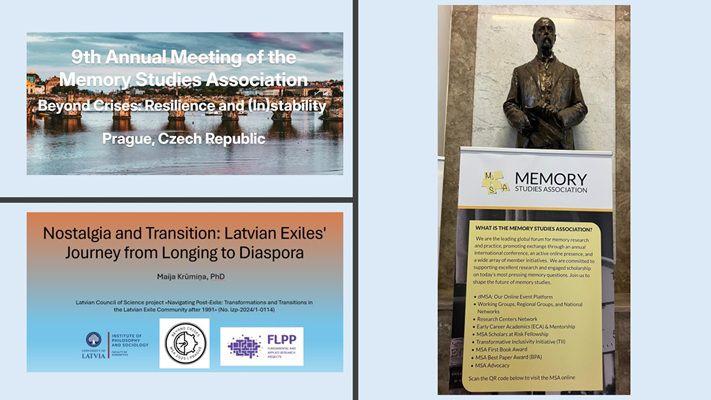
From 14 to 18 July, the principal investigator of the project, Maija Krūmiņa, participated in the Memory Studies Association Conference, «Beyond Crises: Resilience and (In)stability», held in Prague, Czechia. The conference was organised in collaboration with Charles University and the Czech Academy of Sciences.
Maija Krūmiņa presented the paper «Nostalgia and Transition: Latvian Exiles’ Journey from Longing to Diaspora», examining how the restoration of Latvia’s independence in 1991 transformed notions of identity and belonging within Latvian exile communities. Drawing on biographical interviews from the Latvian National Oral History Archive, the study explored how the experience of exile evolved into a diasporic identity and highlighted the central role of memory and nostalgia in this process.
Both papers demonstrate the project’s significant contribution to research on the history of the Latvian exile community and to the international academic dialogue on migration, memory, and identity. By presenting their findings at leading international conferences, the project researchers have not only strengthened the visibility of Latvian scholarship but also fostered comparative discussions on the enduring legacies of exile, return, and diasporic belonging.